


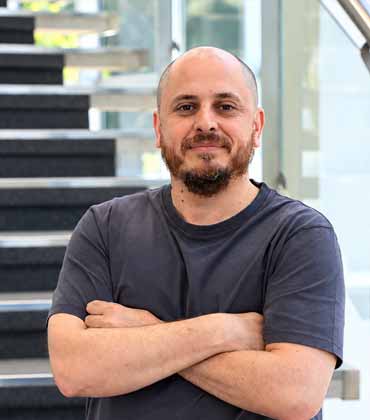
 Dr. Marcos Morgada, Scientific Director
This is what I find most meaningful about UOVO.
UOVO represents a way of approaching biotechnology in which research is not treated as an isolated activity. Science remains at the center, but it develops together with practical understanding, careful planning and continuous learning. A good result in the laboratory is only the beginning. For an idea to become useful, it must survive repeated evaluation, adapt to new evidence and respond to a problem that exists beyond the laboratory.
I believe this integrated way of working is important in biotechnology because uncertainty is unavoidable. Biological systems are complex, results are not always predictable and progress rarely follows a straight line. A strong organization should therefore not be defined by the absence of setbacks, but by its ability to learn from them. The value lies in asking the right questions early, recognizing when an approach needs to change and using each result to make the next decision more informed.
Another aspect I value in UOVO is the importance given to shared knowledge and collaboration. Biotechnology cannot advance through individual effort alone. It requires scientists, technical specialists, operators and people with different forms of experience to work toward a common purpose. When these perspectives are connected, ideas can be examined more completely. This also creates a culture of responsibility. Moving faster is useful only when speed is supported by sound judgment. Producing more data is useful only when the data help us understand what should happen next. Growth is meaningful only when it is built on evidence. For me, this balance between ambition and discipline is one of the strongest principles behind UOVO. It allows innovation to remain bold without becoming disconnected from reality.
More broadly, UOVO reflects an idea that is relevant far beyond one organization. Biotechnology needs spaces where science, experience and execution can meet from the beginning. Too often, promising research remains separated from the structures required to turn it into a useful solution. Closing that distance does not mean reducing science to a commercial objective. It means giving scientific work a clearer path toward impact while protecting its rigor and integrity.
This is particularly significant in regions where access to specialized resources, experienced teams and sustained support can be limited. Building local capacity is not only a response to those limitations; it is a way to create new possibilities. It helps knowledge remain within the ecosystem, strengthens technical independence and allows projects to begin from a stronger foundation. In this sense, the value created by UOVO is not limited to the progress of a single project. It contributes to a wider environment in which biotechnology can mature.
-
Science should be allowed to move, learn and become useful. The objective is not simply to generate ideas, but to create the conditions in which strong ideas can be tested responsibly and transformed into solutions with lasting value.
My view is that the future of biotechnology will depend less on isolated breakthroughs and more on the quality of the systems built around them. Good science will always be essential, but it needs continuity, coordination and a clear relationship with society's needs. UOVO shows how these elements can be brought together in a coherent way.
What I appreciate most is the underlying conviction that science should be allowed to move, learn and become useful. The objective is not simply to generate ideas, but to create the conditions in which strong ideas can be tested responsibly and transformed into solutions with lasting value. That is why I see UOVO not only as a biotechnology organization, but as an example of how scientific ambition can be connected to practical impact.
Advancing Biotech Innovation Through Integrated Research and Venture Development
Biotechnology innovation continues to expand across life sciences, yet the path from laboratory discovery to viable enterprise remains fragmented. Research teams often achieve technical breakthroughs without clear commercial pathways, while early-stage ventures struggle to align scientific progress with funding readiness, regulatory positioning and market access. This disconnect introduces delays, capital inefficiency and missed opportunities for scalable impact. Executives evaluating biotechnology research and startup development partners increasingly prioritize models that compress this gap, aligning scientific execution with venture creation from the outset.
A defining expectation in this space is the ability to connect scientific validation with early market relevance. Programs that advance purely on technical merit without testing real-world demand frequently encounter barriers at later stages. Strong development partners ensure that scientific direction evolves alongside commercial insight, incorporating feedback from potential users, partners and stakeholders early in the process. This parallel progression reduces the risk of building technically sound solutions that lack adoption pathways, particularly in sectors such as healthcare and agribusiness where market entry is complex and concentrated.
Speed of execution has also emerged as a decisive factor. Many research teams remain dependent on external suppliers for critical molecular biology inputs, creating delays that disrupt experimental cycles and extend development timelines. Efficient platforms internalize key capabilities, allowing teams to move through iterative testing and refinement without interruption. Faster experimentation not only accelerates decision-making but also improves capital allocation, ensuring that resources are directed toward scientific advancement rather than logistical overhead.
"Uovotek integrates laboratory infrastructure with venture creation, ensuring that scientific development and company building operate within a unified framework."
Another critical dimension lies in how ventures are structured from inception. Early-stage biotech initiatives often fail because company formation, intellectual property strategy and funding milestones are addressed too late or in isolation. Effective partners integrate these elements into the development process, shaping projects with a clear path to investment readiness. This includes early attention to patent positioning, competitive landscape and milestone design, ensuring that ventures are not only scientifically viable but also structured for scalability and funding engagement.
The ability to leverage shared infrastructure and cross-functional expertise further distinguishes high-performing models. Rather than building each initiative independently, leading platforms create environments where ventures benefit from centralized resources, accumulated knowledge and existing networks. This approach reduces duplication, limits unnecessary expansion and enables disciplined scaling, which is particularly important in regions where access to capital is constrained and execution missteps carry greater consequences.
Within this landscape, Uovotek presents a model that aligns closely with these evolving expectations. It integrates laboratory infrastructure with venture creation, ensuring that scientific development and company building operate within a unified framework. Its process begins with identifying unmet global needs and evaluating whether its internal capabilities can accelerate viable solutions, allowing it to design ventures around technologies it can directly support.
Its structure enables projects to advance through both technical development and business formation in parallel, reducing the distance between proof of concept and investment readiness. Internal platforms for peptide synthesis, DNA sequencing, oligo synthesis and synthetic genes allow faster experimental cycles, shifting development from waiting-based timelines to rapid iteration. The model also incorporates early market validation, intellectual property planning and milestone design, ensuring that ventures are shaped for both scientific and commercial success. This integrated approach positions it as a compelling choice for executives seeking disciplined, capital-efficient pathways to build scalable biotechnology enterprises.
...Read more
